When launching a new business or product, protecting your brand identity is one of the most critical steps you can take. A trademark acts as a silent salesperson and a badge of origin, ensuring consumers can easily distinguish your goods or services from competitors in a crowded market. However, many entrepreneurs mistakenly believe that trademarks are strictly limited to standard business names or corporate logos. In reality, the scope of intellectual property law is vast, allowing you to secure a trademark registration for a wide array of distinctive commercial assets.
Today, safeguarding these unique brand elements is faster and more accessible than ever thanks to online trademark registration. Whether you are protecting a catchy corporate slogan, a distinct product shape, or a specific jingle, understanding exactly what qualifies for protection will help you build a robust and legally secure brand portfolio.
Traditional Trademarks: Words, Names, and Logos
The most common and familiar forms of intellectual property protection fall under traditional marks. These are the visual and text-based elements that immediately come to mind when people think of branding:
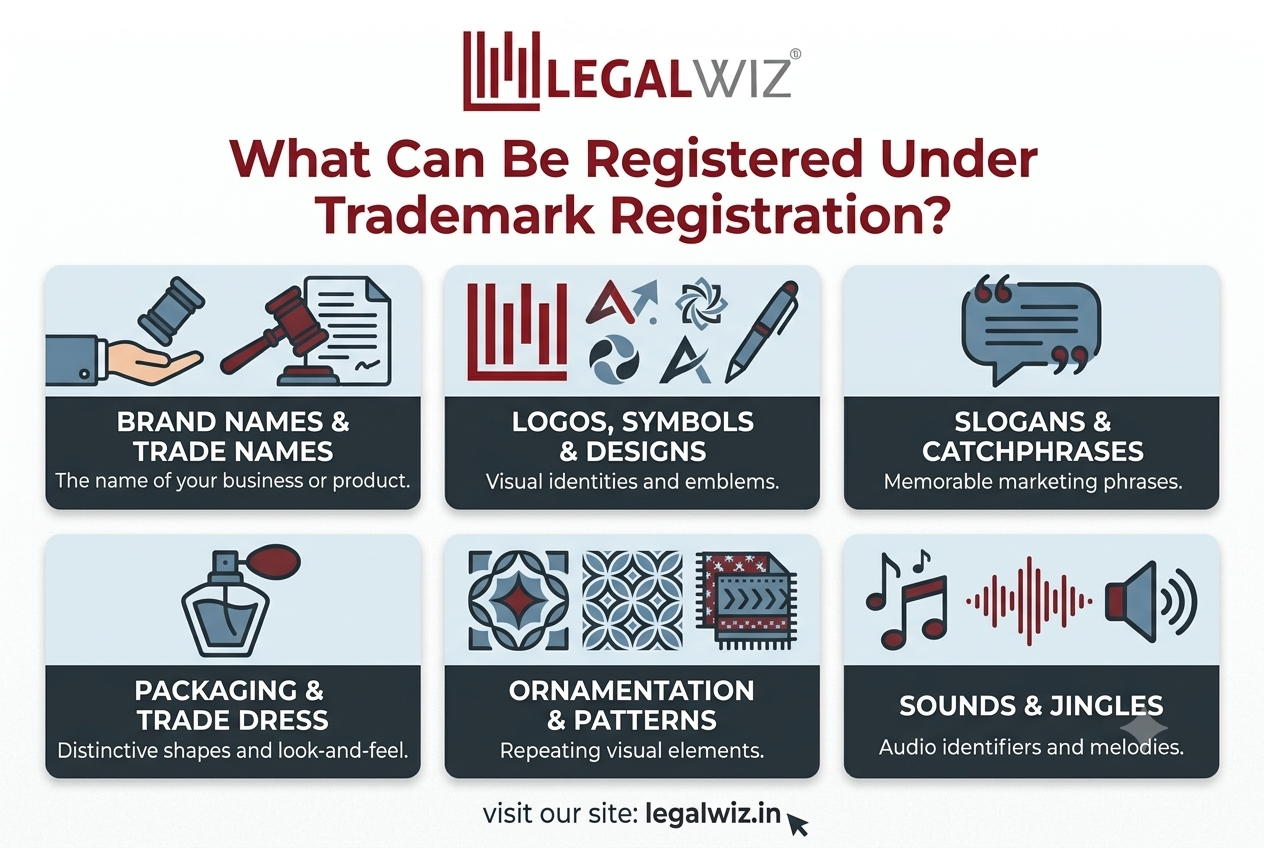
- Words and Brand Names: This includes coined or invented words (e.g., “Google” or “Exxon”), arbitrary words used in an unrelated context (e.g., “Apple” for computers), and surnames or personal names (e.g., “Disney” or “Ford”).
- Logos and Symbols: Unique graphic designs, stylized text, emblems, and printed figures that identify a company without needing to read the full brand name. Think of Nike’s “swoosh” or the Apple silhouette.
- Slogans and Taglines: Catchy phrases, mottos, or taglines used in marketing campaigns to define the philosophy of a product or service (e.g., “Just Do It”).
- Letters and Numerals: Abbreviations, single letters, or number combinations that have established distinctiveness in trade, such as “HP” or “555”.
To register these traditional elements, they must be distinctive and not merely descriptive of the product itself. For example, you cannot trademark the word “apple” if you are selling fresh fruit, but you can if you are selling consumer electronics.
Non-Traditional and Unconventional Marks
Beyond standard words and visuals, modern intellectual property laws recognize that brand identity extends into sensory and dimensional experiences. You can protect unconventional markers of commercial origin, provided they serve to identify the source and do not serve a purely utilitarian or functional purpose:
- Shape Marks: The three-dimensional shape of a product or its packaging. Distinctive, non-functional shapes—such as the unique contour of a Coca-Cola bottle or the triangular prism of Toblerone chocolate—can be legally protected.
- Colour Marks: A single color or a specific combination of colors strongly associated with a brand’s identity. Famous examples include “Tiffany Blue” for luxury jewelry and “Cadbury Purple” for confectionery packaging.
- Sound Marks: Distinctive auditory signatures or jingles that instantly alert consumers to the source of a good or service. Notable sound marks include the Intel inside chime, the MGM lion’s roar, and specific corporate banking jingles.
- Trade Dress: The overall visual appearance and “look and feel” of a product or its packaging, including texture, layout, and color combinations. A classic example is the minimalist, clean layout of an Apple retail store.
- Motion and Hologram Marks: Animated sequences or holograms used as a logo, such as Lamborghini’s animated charging bull or Nokia’s classic connecting-hands motion.
- Certification and Collective Marks: Certification marks (like the “AGMARK” or “ISI” symbols) alert the public that a product meets specific quality standards set by a certifying body. Collective marks indicate membership in an organization or association.
What Cannot Be Registered?
While the possibilities are nearly endless, not every brand asset can be monopolized. The law strictly prohibits certain types of marks from gaining exclusivity:
- Generic Terms: Common, everyday words that describe the product itself (e.g., using the word “Bicycle” for a bicycle shop) cannot be registered because they must remain available for all traders to use.
- Deceptive Marks: Signs that mislead the public about the origin, quality, nature, or ingredients of a product (e.g., labeling a synthetic fabric as “100% Organic Silk”).
- Offensive or Immoral Marks: Symbols, phrases, or imagery that go against public order, decency, or religious sentiments.
- Official State Emblems: Flags, national symbols, or government seals belonging to countries or international organizations.
- Functional Shapes: If the shape of a product is purely functional—meaning it is essential to how the product works rather than how it looks—it cannot be claimed as a trademark (though it might qualify for a patent).
Securing Your Intellectual Property
Navigating the nuances of intellectual property can feel daunting, but securing official rights is essential for preventing counterfeits, stopping unfair competition, and increasing your overall business value. Fortunately, modern platforms have simplified the process of online trademark registration, allowing business owners to apply, track applications, and manage certificates directly through government intellectual property portals without excessive paperwork.
Before submitting an application, it is highly recommended to conduct a comprehensive trademark search to ensure your chosen asset is wholly unique and does not infringe upon existing registered marks. By carefully selecting and legally securing your distinctive brand identifiers—whether they are visual logos, catchy jingles, or unique product packaging—you establish long-term legal certainty and build an enduring market presence.
Frequently Asked Questions
How long does a registered trademark last?
Typically, trademark protection is valid for 10 years from the date of filing. However, unlike patents or copyrights, it can be renewed indefinitely for additional 10-year periods as long as you pay the renewal fees and continue to use the mark in commerce.
Can I register a trademark internationally?
Yes. While a standard trademark only provides protection within the country of registration, you can extend your protection globally. You can either file individual applications in each target country or use the Madrid System, administered by the World Intellectual Property Organization (WIPO), to seek protection across multiple member countries with a single centralized application.
What is the difference between a trademark (TM) and a registered trademark (R)?
The “TM” symbol can be used by anyone claiming ownership over a mark, serving as an informal warning to competitors that you consider it your brand identifier, even while your application is pending or unfiled. The encircled “R” (®) symbol, however, can only be legally applied once your mark has officially completed the registration process and been granted a certificate by the relevant government intellectual property office. Using the ® symbol prematurely can lead to legal penalties.