Starting a new business venture is an exhilarating journey, filled with strategic decisions, market positioning, and growth roadmaps. However, before a business can legally service its first client, hire formal employees, or issue its initial corporate invoice, it must secure formal corporate existence. In the modern corporate landscape, transitioning from a conceptual startup to a legally recognized corporate entity has been dramatically simplified through digital transformation. Opting for a company registration online procedure ensures transparency, speed, and regulatory compliance from the comfort of your workspace.
Among various business structures, the Private Limited (Pvt Ltd) framework remains the golden standard globally for entrepreneurs who seek outside investment, value limited liability protection, and wish to project institutional credibility. Navigating a private limited company registration online requires a clear understanding of documentation rules, financial outlays, and execution timelines. This comprehensive checklist serves as an end-to-end framework to prepare corporate founders for an efficient registration process.
1. The Foundation: Strategic Structuring Metrics
Before gathering physical documentation, founders must establish the fundamental architectural parameters of their future company. These metrics dictate the legal boundaries of the registration paperwork:
- Director Architecture: Most jurisdictions require a minimum of two directors for a private limited structure, with at least one being a resident national.
- Shareholder Distribution: Corporate ownership must be clearly mapped out. Shareholders can be individuals or corporate entities, split by defined share percentages.
- Capital Allocation: Founders must declare both Authorised Capital (the maximum value of shares the company is legally permitted to issue) and Paid-up Capital (the actual capital injected by shareholders during incorporation).
2. Document Checklist for Incorporation
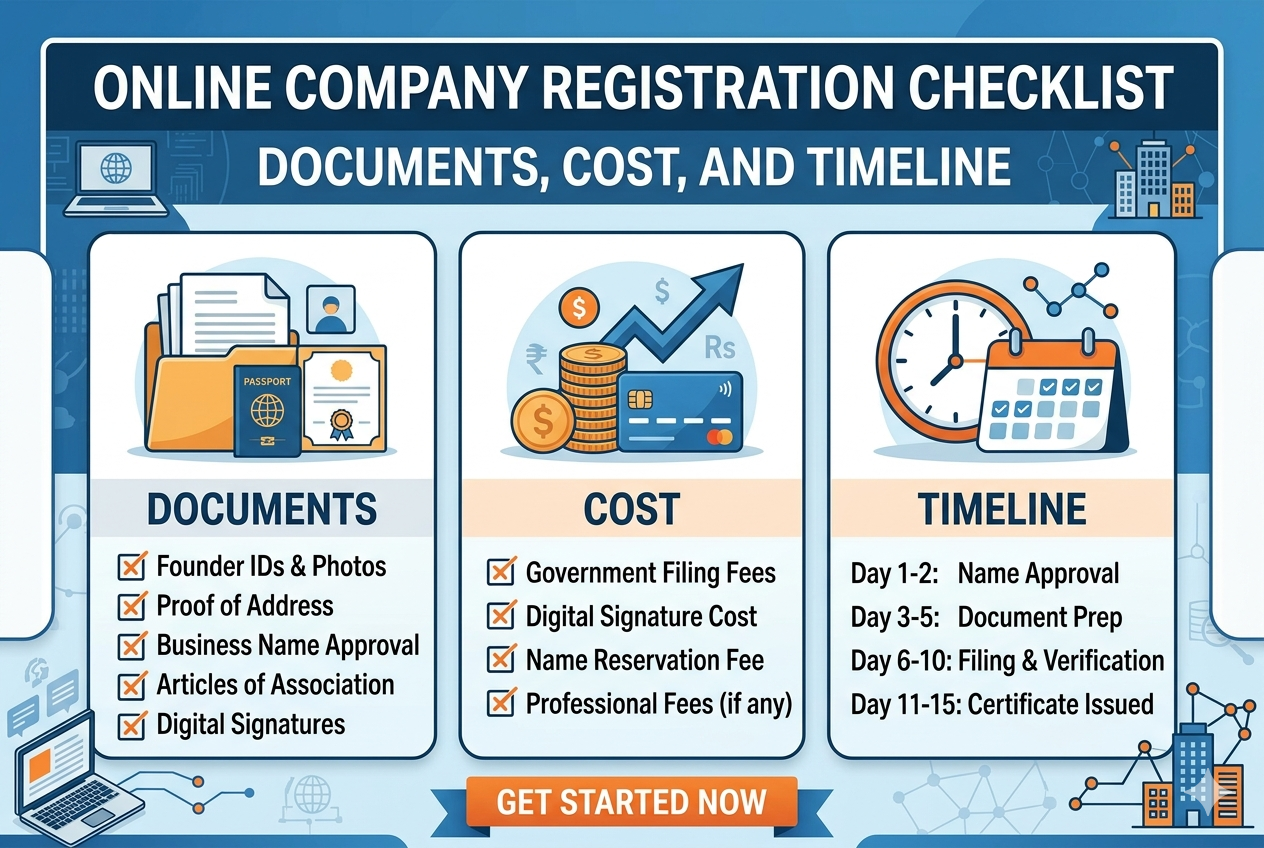
The success of an online application hinges entirely on documentation accuracy. Inconsistent spelling, blurry scans, or expired credentials will trigger immediate structural rejections from corporate registrars. Gather the following items well in advance:
Part A: Requirements for Directors and Shareholders
- Digital Signature Certificates (DSC): Because the entire framework is executed electronically, directors must obtain authorized secure digital signature tokens to sign the statutory filing forms.
- Identity Verification Docs: High-resolution color scans of Government-issued Identity Cards, passports (mandatory for foreign nationals), and specialized national tax identity numbers (such as PAN cards).
- Address Verification Proofs: Bank account statements, utility invoices (electricity, water, gas), or mobile bills showing the applicant’s name clearly. These documents must be recent, typically not exceeding two months old.
- Passport Photographs: Clean, white-background digital portraits for structural filing portals.
Part B: Requirements for the Registered Corporate Office
A private limited entity must possess a valid, physical address where official judicial notices and regulatory correspondences can be received.
- Ownership or Tenancy Agreements: A formal rental/lease agreement executed between the property owner and the prospective company, or property ownership deeds if the space is owned by a director.
- No Objection Certificate (NOC): A signed document from the explicit property landlord stating zero objections to the premises being used as a registered corporate headquarters.
- Utility Proof of Premise: A recent electricity or water utility invoice clearly stating the exact address structure matching the registry portal.
Pro-Tip: Ensure that names across identity proofs precisely match the spelling on utility bills. A minor variation like “Street” versus “St.” can halt your registration sequence.
3. Cost Structure Breakdown
The total financial investment required to finalize an incorporation application online can be broken down into three major distinct buckets: statutory government levies, mandatory technical components, and professional facilitation fees.
| Expense Category | Underlying Components Included | Estimated Cost Scale |
|---|---|---|
| Technical Infrastructure | Digital Signature Certificates (DSC) & Director Identification Numbers (DIN) | Minimal / Nominal |
| Government Levies | Name Approval fees, Stamp Duty on Charter Docs (MoA/AoA), Filing Fees | Scales with Authorised Capital |
| Professional Fees | Chartered Accountants, Corporate Lawyers, or Digital Compliance Platforms | Varies based on service tier |
| Post-Incorporation Basics | Corporate Tax ID allocation, Corporate Seal, First Board Resolution | Variable / Optional bundles |
Government fees fluctuate significantly depending on your geographic location and the amount of authorized capital you declare. Many jurisdictions have waived basic incorporation fees for small-scale startups to foster innovation, meaning you only pay for local stamp duties and minor administrative registrations.
4. Step-by-Step Incorporation Timeline
While an online registration workflow is substantially faster than traditional paper filings, it still involves sequential dependencies. The end-to-end framework generally spans 10 to 14 business days, outlined below:
Phase 1: Procurement of Digital Infrastructure (Days 1–2)
The corporate formation starts with securing secure Digital Signatures (DSC) for all designated directors. Simultaneously, background application checks for Director Identification Numbers are executed via central online databases.
Phase 2: Corporate Nomenclature Reservation (Days 3–5)
Founders submit their preferred company names to the registry. The proposed name must be completely unique, devoid of trademarks held by other entities, and reflective of the company’s core operations. Up to two options are typically proposed sequentially to prevent rejection delays.
Phase 3: Crafting Charter Documentation (Days 6–8)
Once the corporate name is officially reserved, legal professionals construct the company’s constitution: the Memorandum of Association (MoA), which defines the scope of corporate operations, and the Articles of Association (AoA), detailing inner corporate governance frameworks.
Phase 4: Digital Package Submission & Approval (Days 9–12)
The finalized MoA, AoA, identity proofs, and office utility documents are unified into a single structural electronic filing form. After paying the relevant stamp duty and filing fees online, the application goes live for reviewer processing. If the registrar finds the package complete, they issue an official Certificate of Incorporation (CoI).
Final Strategic Milestones
Receiving the Certificate of Incorporation marks the legal birth of your enterprise. However, before operational execution can begin, two final steps are mandatory. First, founders must leverage the new incorporation papers to establish a dedicated corporate bank account. Mixing personal and business capital invalidates the corporate veil that shields founders from liability. Second, you must activate corporate tax numbers and localized operational licenses. Utilizing a systematic company registration online route combined with this structured checklist ensures your new enterprise enters the commercial market on a legally flawless foundation.