Building a high-performance car audio system is about more than just picking out the loudest subwoofers or the most feature-packed head unit. The true backbone of any great mobile audio setup is its electrical infrastructure. If your amplifiers can’t get the juice they need from your battery and alternator, you’ll suffer from voltage drops, clipped signals, overheating equipment, and subpar sound quality.
When you are plumbing your vehicle for massive amounts of current, you will inevitably face the confusing world of wire gauges and termination hardware. Understanding AWG wire sizing is absolutely critical when you are shopping for car audio lugs and car audio battery lugs. Using the wrong size can choke your system’s performance or, worse, create a serious fire hazard.
What is AWG and Why Does It Matter?
AWG stands for American Wire Gauge, a standardized wire gauge system used predominantly in North America for the diameters of round, solid, nonferrous, electrically conducting wire.
The most important thing to remember about the AWG system is that it operates on an inverse relationship:
The Rule of AWG: The smaller the gauge number, the larger the physical diameter of the wire, and the more current (amperage) it can safely carry.
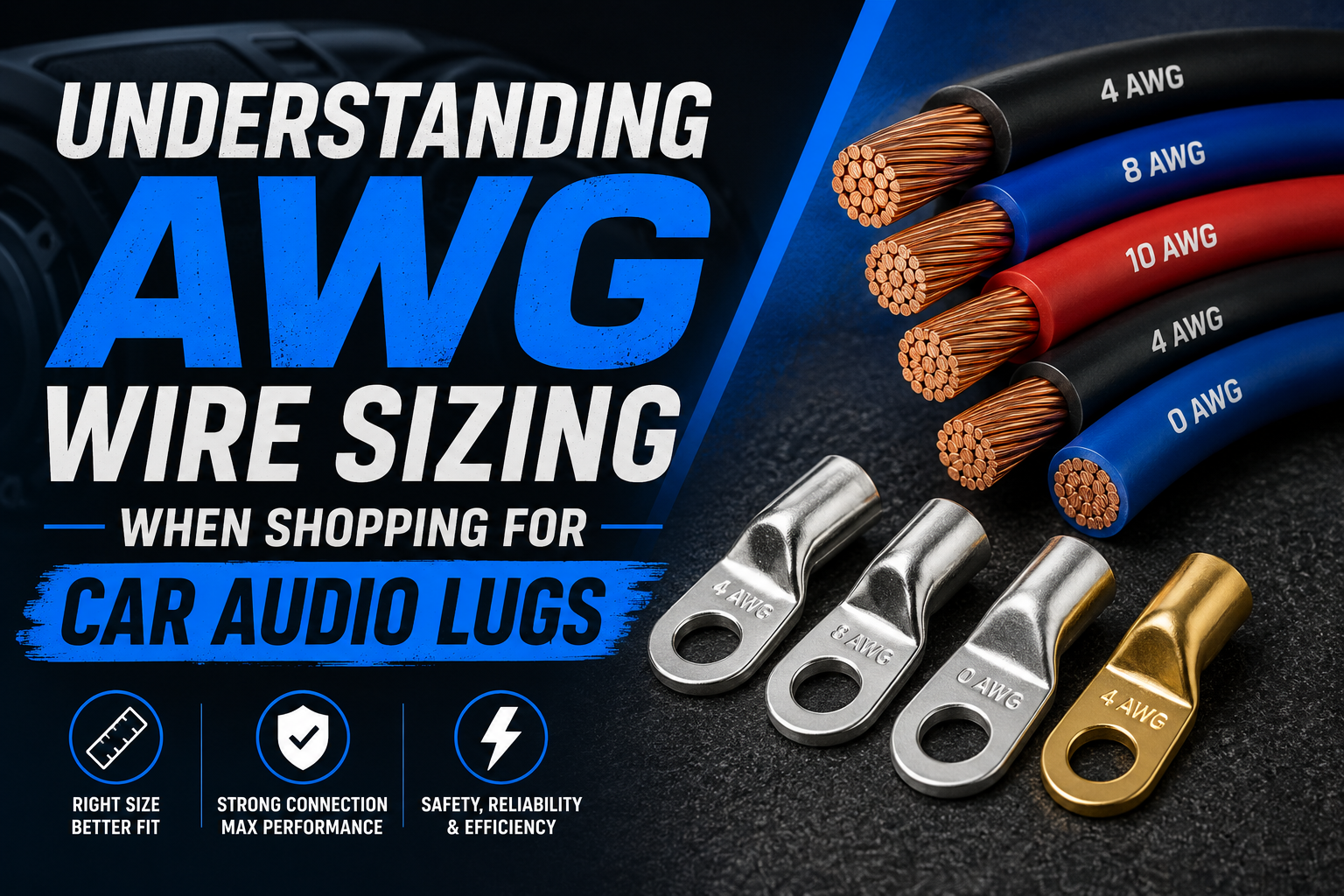
For example, a 10 AWG wire is relatively thin and suited for smaller speakers or low-power components. On the other hand, a 1/0 AWG (often pronounced “one-aught”) or a 2/0 AWG (“two-aught”) wire is thick, heavy, and designed to feed massive, multi-thousand-watt amplifiers directly from the vehicle’s electrical system.
The Car Audio Conundrum: AWG vs. Gauge vs. MM²
When shopping for car audio lugs, you will quickly notice a frustrating lack of consistency in the marketplace. Some brands sell “1/0 AWG Lugs,” others sell “1/0 Gauge Lugs,” and overseas manufacturers often list them by cross-sectional area in square millimeters ($mm^2$).
Are “AWG” and “Gauge” the same thing? In a perfect world, yes. But in the car audio industry, they often are not.
1. True AWG (American Wire Gauge)
True AWG wires adhere strictly to standard dimensions. A true 1/0 AWG copper wire has a specific conductor diameter of roughly 0.325 inches (8.25 mm).
2. “Gauge” or “Oversized” Wire
Many budget-tier car audio brands sell “Oversized Gauge” or simply “Gauge” wire. This wire often has a thicker plastic jacket but a thinner copper core to save on manufacturing costs. If you buy a cheap “1/0 Gauge” wire, it might actually only have the copper content of a 2 AWG or 4 AWG true AWG wire.
3. Metric Sizing ($mm^2$)
If you buy high-quality, industrial-grade car audio battery lugs, they are frequently sized in metric units.
| Standard AWG Size | Equivalent Cross-Sectional Area | Common Industrial Metric Lug Size |
|---|---|---|
| 4 AWG | ~$21.2 mm^2$ | $25 mm^2$ |
| 2 AWG | ~$33.6 mm^2$ | $35 mm^2$ |
| 1/0 AWG (0 GA) | ~$53.5 mm^2$ | $50 mm^2$ or $60 mm^2$ |
| 2/0 AWG (00 GA) | ~$67.4 mm^2$ | $70 mm^2$ |
Why Wire Type Changes the Lug Size You Need
Before you click “Add to Cart” on a set of car audio lugs, you must know what your wire is made of. The two dominant types of wire in the car audio world are OFC (Oxygen-Free Copper) and CCA (Copper-Clad Aluminum).
Because aluminum is less conductive than copper, a CCA wire must be significantly thicker than an OFC wire to carry the exact same amount of electrical current. Consequently, many manufacturers make their CCA wires “oversized” to compensate for this performance gap.
If you try to stuff an oversized 1/0 CCA wire into a standard, tightly spec’d 1/0 AWG pure copper heavy-duty lug, it simply won’t fit. You may have to step up to a 2/0 lug or look specifically for lugs explicitly labeled for car audio use, which tend to have slightly wider barrels to accommodate oversized strands and high flexibility counts.
Anatomy of Car Audio Lugs: How to Choose
When shopping for hardware to secure your power and ground cables to your amplifiers, chassis, or car audio battery lugs, you need to look at three primary specifications:
[ Barrel Diameter ] [ Hole Diameter ]
| |
v v
=============———————.
[ Bare | Ring Eyelet ( O )
=============———————‘
1. The Barrel Inside Diameter (I.D.)
This is the opening where your stripped copper wire is inserted. This must match your wire’s true outer diameter (minus the insulation jacket). If the barrel is too large, your crimp won’t be secure, creating electrical resistance and heat. If it’s too small, you’ll be forced to trim away copper strands to make it fit, effectively lowering your wire’s current capacity.
2. The Ring / Stud Hole Size
This is the hole that fits over your battery terminal bolts, grounding bolts, or amplifier inputs. Common sizes include:
- #10 (for small amplifier barrier strips)
- 1/4-inch (common for grounds and distribution blocks)
- 5/16-inch and 3/8-inch (standard sizes for most car audio battery lugs and factory alternator posts)
3. Material and Plating
Look for lugs made of pure electrical-grade copper (C110 or similar). For automotive applications, ensure they are tin-plated. Tin plating prevents the copper from oxidizing and turning green when exposed to the moisture and heat under your vehicle’s hood.
Tips for a Flawless Crimp
Once you have matched your AWG wire to the perfect car audio lugs, your final step is installation. Avoid using pliers or a hammer to smash the lug onto the wire. A poor crimp introduces resistance, which drops your voltage and compromises your sound.
Instead, invest in a hydraulic hex crimper or a heavy-duty mechanical indentation tool. A proper hex crimp cold-welds the wire strands and the lug barrel into a single, solid chunk of metal, ensuring maximum current transfer and zero voltage drops. Finish the connection with a piece of marine-grade, adhesive-lined heat shrink tubing to seal out oxygen and moisture completely.
Final Thoughts
When designing your car audio system’s electrical backbone, do not guess on your measurements. Take the time to verify whether your wire is True AWG, OFC, or CCA. By understanding the intricacies of AWG wire sizing, you can confidently shop for the exact car audio lugs and car audio battery lugs you need, ensuring your system plays loud, stays cool, and hits hard for years to come.